
Pericoronitis: Wisdom Tooth Infection Symptoms, Risks and Treatment
That dull ache at the back of your mouth that keeps coming back? It might not be the wisdom tooth itself causing the problem — it could be the gum around it. Pericoronitis is one of the more common and underestimated complications of wisdom teeth. It can escalate quickly, and it rarely resolves on its own.
Here is what you need to know.
What Is Pericoronitis?
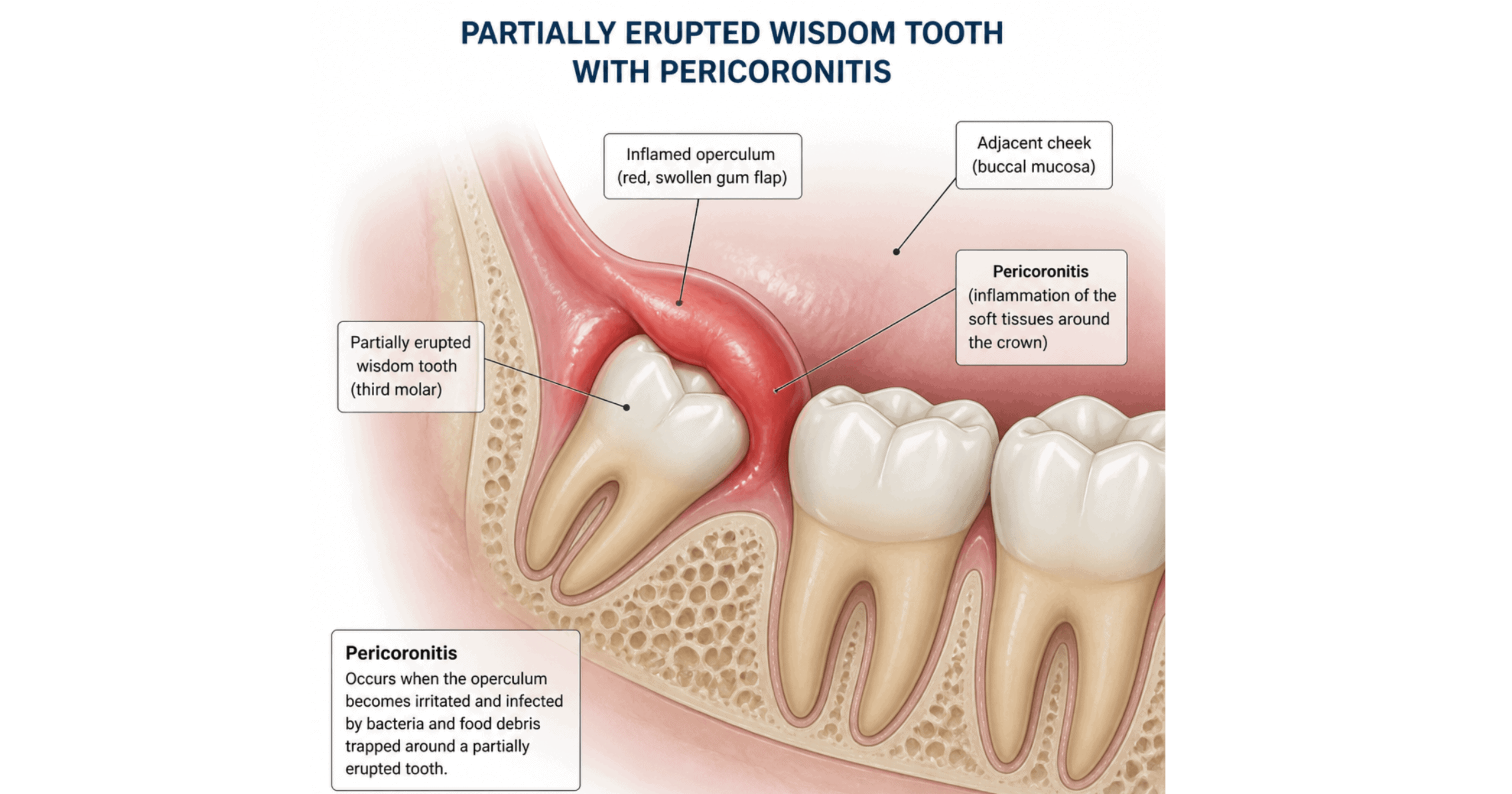
Pericoronitis is an infection affecting the gum tissue around a partially erupted wisdom tooth. When a wisdom tooth does not fully break through the gum, it leaves a flap of soft tissue — called an operculum — covering part of the tooth’s surface.
That flap becomes a trap. Food debris, bacteria, and plaque accumulate underneath it in a space nearly impossible to clean properly. The result is inflammation and infection in the surrounding gum tissue.
It is one of the most common complications associated with wisdom teeth, particularly in people aged 20 to 30. Because the infection sits in a tight, warm, moist space, it can worsen rapidly — particularly when the upper wisdom tooth presses against the swollen tissue below, increasing irritation and speeding up the cycle.
Pericoronitis can be acute (sudden onset, short duration) or chronic (low-grade, recurring). Both require attention. Chronic pericoronitis is particularly problematic because it can smoulder quietly for months, causing mild but persistent discomfort, until it flares into a more serious acute episode.
Symptoms of Pericoronitis
The symptoms of pericoronitis vary depending on whether the infection is mild or has progressed. Some people experience only localised discomfort; others find it difficult to eat, speak, or open their mouth properly.
Common symptoms include:
- Swollen, red, or tender gum at the back of the mouth, usually around the lower wisdom tooth
- A persistent bad taste or unpleasant smell, often caused by discharge or trapped bacteria under the gum flap.
- Radiating pain affecting the jaw, ear, or throat
- Difficulty opening the mouth fully — a condition called trismus, caused by inflammation affecting the surrounding muscles
- Facial swelling, particularly along the jaw or cheek
- Fever or general feeling of being unwell
- Difficulty swallowing
Not all of these will be present at once. In mild cases, the main signs are localised swelling and discomfort that appear to settle, then return.
If you are experiencing facial swelling alongside fever or difficulty swallowing, do not wait for a routine appointment — those symptoms together require prompt attention.
Why Wisdom Teeth Are Prone to This Infection
Wisdom teeth — the third molars — tend to be the final teeth to erupt, most often during the late teens or early twenties. In many people, the jaw does not have enough space to accommodate them, which can result in impaction or partial eruption, where only part of the tooth emerges through the gum.
Partial eruption is the primary reason wisdom teeth are so susceptible to pericoronitis. Once a gum flap forms, it creates a space that toothbrush bristles and floss cannot reach effectively. Bacteria colonise this area, and the immune response triggered by that bacterial presence causes the surrounding tissue to become inflamed.
The anatomy of the back of the mouth makes this worse. There is less room to manoeuvre, visibility is poor, and the tissue is under constant pressure from chewing. The upper wisdom tooth, if present, can repeatedly bite down onto the inflamed flap of the lower gum, keeping the area irritated and preventing it from settling.
Immediate Treatment
If you develop pericoronitis, the goal of initial treatment is to manage the infection, reduce inflammation, and relieve discomfort while a longer-term plan is determined.
Antibiotics
If the infection has progressed beyond localised inflammation, or if there are signs of systemic involvement such as fever or swelling spreading to the face or neck, antibiotics may be prescribed. They help bring the infection under control but do not address the underlying cause.
Warm salt water rinses
Rinsing with warm salt water several times a day helps reduce bacteria in the area and supports the gum tissue. Use about half a teaspoon of salt in a glass of warm water.

Gentle cleaning
A dentist may carefully clean under the gum flap to remove trapped food and bacteria. This is not something that should be attempted at home.
Pain management
Over-the-counter analgesics can help manage discomfort in the short term. Your Gordon dentist will advise on what is appropriate given your circumstances.
The most important step is seeing a dentist promptly. Pericoronitis is not something to manage independently for an extended period. The sooner the infection is assessed, the sooner an appropriate treatment path can be confirmed.
When Removal Is the Best Option
For many people with pericoronitis, wisdom tooth extraction is the most effective long-term solution. If the tooth is partially erupted and unlikely to fully emerge into a functional position — or if there is not enough room in the jaw — removing it eliminates the problem at its source.
Removal is typically recommended in these situations:
- Recurrent infections — If pericoronitis has occurred more than once within a relatively short period, conservative management is not a sustainable long-term approach.
- Damage to adjacent teeth — A partially erupted wisdom tooth can put pressure on the second molar beside it, leading to bone loss, decay, or root damage in a tooth that would otherwise be healthy.
- Cyst formation — Around impacted wisdom teeth, fluid-filled cysts can develop in the surrounding bone. If left untreated, these can cause bone loss and complicate future treatment.
- Structural position — If the wisdom tooth is angled or positioned in a way that makes it non-functional or impossible to clean, extraction prevents future complications rather than waiting for them to develop.
Where possible, extracting the tooth during a settled period — when infection is not active — is preferable. Healing is more predictable, and the procedure is simpler.
What Happens If You Ignore It?
Pericoronitis does not reliably resolve without intervention. The gum flap remains, the bacteria always have a pathway back in, and each recurring episode carries the same risk of escalation as the first.
If left unaddressed, pericoronitis can progress to more serious complications:
- Spread of infection — Dental infections can spread beyond the immediate site. Cellulitis — a spreading bacterial infection of soft tissue — can develop in the jaw, neck, or floor of the mouth. In severe cases, this can compromise the airway and become a medical emergency.
- Abscess formation — A localised collection of pus can form around the wisdom tooth or in the adjacent tissue, requiring drainage in addition to antibiotic treatment.
- Bone loss — Chronic infection around a tooth erodes the surrounding bone over time, affecting both the wisdom tooth and potentially the second molar beside it.
- Damage to neighbouring teeth — Prolonged pressure and infection can lead to decay or root resorption in the adjacent molar, a tooth that is otherwise sound and worth preserving.
- Ludwig’s angina — Though less common, a serious infection of the floor of the mouth can originate from untreated dental infections and requires emergency hospital treatment.
Frequently Asked Questions
Can antibiotics cure pericoronitis permanently?
No. Antibiotics treat the active infection and reduce inflammation, but once the course is finished, the conditions for another episode remain. For a permanent resolution, the partially erupted tooth or gum flap needs to be addressed directly.
How fast can a wisdom tooth infection spread?
Dental infections can progress quickly, particularly when left untreated for several days. Swelling extending to the jaw, cheek, or neck — or symptoms such as fever and difficulty swallowing — indicate spreading infection and require urgent dental or medical attention.
What if my pericoronitis keeps coming back?
Recurring pericoronitis is a clear indication that the tooth needs to be extracted. Conservative management is appropriate for an initial episode, but repeated infections indicate the tooth will not erupt into a position that allows proper hygiene or function.
What is the difference between an emergency and a planned wisdom tooth removal?
Emergency extraction is reserved for situations where infection is severe or spreading. Planned extraction, performed once any acute infection has settled, is generally preferable — healing is more predictable, and the procedure is simpler.
Will the infection go away on its own?
Occasionally, a very mild episode settles briefly, but it cannot be relied upon. Without removing the source of bacterial accumulation, the infection will return.
Wisdom Tooth Extraction in Gordon
If you have been experiencing pain, swelling, or recurring discomfort in the back of your mouth, it is worth getting it assessed sooner rather than later. At Northern Dental Gordon, we regularly see patients with pericoronitis, and the earlier it is addressed, the more straightforward the management.
We serve patients from Gordon and surrounding areas, including Pymble, Killara, Lindfield, and St Ives.
Call us on (02) 9498 8290 or book online to arrange an appointment.
Visit us at Suite 3, 2 St Johns Ave in Gordon.